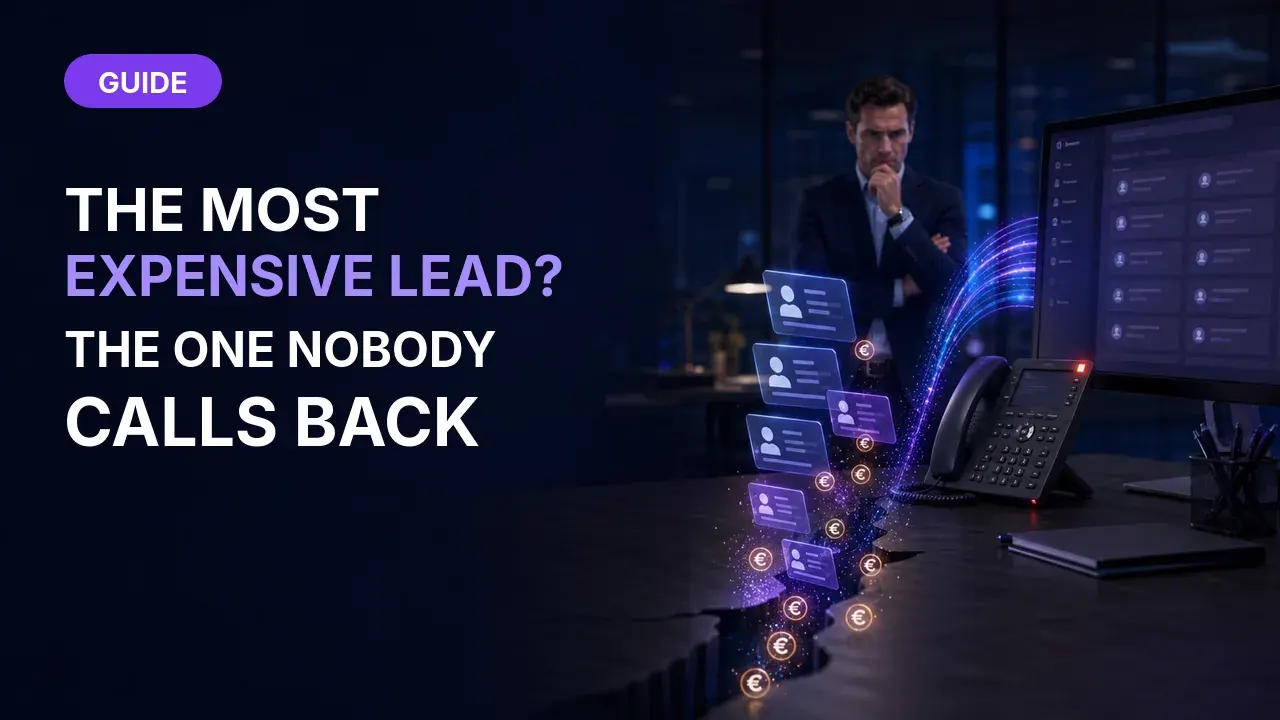

The challenge is not only generating interest. It is acting before that interest changes direction.
There is a moment in every lead journey when your company does not have to persuade the prospect to listen: they are already listening.
It is the moment immediately after a form is submitted. The person has just seen an ad, read a page, considered a promise and decided it was worth sharing a phone number. We do not know whether they will buy or even whether they are a good fit. But we do know something that will be less true a few hours later: right now, they are thinking about the problem your company might solve.
Yet this is exactly where many companies stop. The form enters the CRM, a notification fires and the record is assigned. A salesperson sees it after a meeting, after finishing the previous call or when they finally catch up with accumulated tasks. Nobody has necessarily made a mistake. The system has done exactly what it was designed to do.
In the meantime, however, the lead has moved on.

The first competitor for a new opportunity is not always another company. It is time.
A form records a decision, not permanent availability
On an advertising dashboard, every submission looks like a stable result: one more lead, one more row, one updated acquisition cost. Behind that number, however, is a person in motion.
They may have completed two other forms. They may have received a call, returned to work or started comparing reviews, prices and alternatives. Interest does not necessarily disappear, but it loses the context that made it easy to activate.
Call immediately and you do not need to explain why you are calling: they remember. Call the next day and you may have to reconstruct the scene. Call a week later and you risk sounding like the interruption, even though the person originally asked for information.
This is what CPL alone cannot show. The advertising platform measures the moment a contact was generated. It does not measure how much value faded while that contact waited to be worked.

Five minutes is not a magic formula
The so-called five-minute rule is often presented as an absolute threshold: before five minutes a lead converts; after five minutes it does not. That simplification creates urgency, but it should not be taken literally.
The most frequently cited research tells a more useful story. James Oldroyd, Kristina McElheran and David Elkington studied how more than 2,200 companies handled online leads. Businesses that attempted to contact a lead within an hour were almost seven times more likely to qualify that lead than those that waited even one hour longer, and more than sixty times more likely than those that waited at least 24 hours.
The study appeared in Harvard Business Review as “The Short Life of Online Sales Leads”. It is a 2011 US study, not a universal benchmark for every industry in 2026. The operational principle is still useful: speed preserves context, reduces the effort required to be recognised and leaves less room for alternatives and distractions.
The first five minutes are therefore primarily an organisational test. If your company cannot reach a lead in that window, the useful question is not “why wasn't the salesperson faster?” It is: which part of our process assumes that a person will always be free at the exact moment a request arrives?
Salespeople cannot live in front of notifications
Picture a capable salesperson in the middle of a working day. They are managing a negotiation, preparing a proposal, updating the CRM and calling back somebody who did not answer yesterday. Three new leads arrive in the meantime.
If the salesperson drops everything to work them immediately, existing opportunities suffer. If they finish what they are doing, the new contacts wait. This is not a choice between working well and working badly. It is a choice between legitimate priorities competing for the same time.
More notifications do not solve the problem. A notification transfers responsibility; it does not create operating capacity.
Response speed should therefore not depend on heroic behaviour from the sales team. It should be a property of the process.

The gap many integrations do not close
Technically, it is already possible to move a lead from an advertising platform into a CRM very quickly. Google Ads can send lead data straight to a CRM through webhooks, APIs and third-party integrations. Its official webhook integration documentation explains that data can be delivered with an HTTP request immediately after a form is submitted.
Those integrations solve data transport. They do not necessarily solve ownership.
If a lead reaches the CRM in two seconds but receives a call three hours later, the company has automated storage, not the relationship. It is like delivering a request to a salesperson's desk more efficiently while still waiting for the desk to clear.
A lead transferred in real time but worked late is only a better-documented wait.
What changes when Agendly is connected to the form
The reasoning behind Agendly is simple: if form submission represents peak attention, why use that moment only to create a CRM task?
When Agendly is connected to the acquisition flow, the form is no longer where the process stops. It becomes the event that starts it.
The new contact can be handled straight away. Agendly starts the call — or multiple calls concurrently — while the request is still fresh and opens with the right context: the requested service, the source campaign and information already provided in the form.
This detail matters. Speed on its own can become noise. An immediate but generic call may feel aggressive. An immediate, contextual call feels like the natural continuation of the action the lead has just taken.

At that point, Agendly does not need to sell at any cost. It needs to understand.
It can verify the need, timing, company-defined requirements and willingness to speak with an adviser. If the contact is not a fit, sales avoids spending time on a weak opportunity. If the conditions are there, the conversation can proceed directly to selecting a slot in the connected calendar.
That is the most important change: the lead is not qualified today only to be called back tomorrow. Qualification and appointment booking can happen inside the same window of attention.
From form to the sales calendar without a second call
Follow the journey from the lead's perspective.
1. A person submits a form because they want information, an assessment or a quote.
2. Data already collected — such as name, number, requested service and previous answers — provides context.
3. Agendly calls without waiting for an operator to see a notification or clear space in the day.
4. During the conversation, it asks the questions agreed with the company and checks need, timing, minimum requirements and willingness to proceed.
5. If the lead qualifies, it checks the connected calendar and offers genuinely available times.
6. The chosen slot is added directly to the salesperson's calendar with the information collected during qualification.
The salesperson finds the meeting already scheduled and enters the conversation knowing who they will meet, what need was expressed and why the contact was considered relevant.
This removes three waits: the delay before first contact, the delay required to qualify the lead and the delay involved in manually coordinating availability. Most importantly, the lead does not need a second call simply to agree on a day and time.

The result is not merely a lead delivered faster. It is interest transformed into an appointment already present in the sales calendar.
Why reducing the wait can increase appointments
Claiming that a system “guarantees more appointments” would be misleading if that meant a mathematical promise. No automation can repair an unclear offer, poor targeting or a lead that lacks the necessary requirements.
Agendly can make something more concrete verifiable:
- the request enters the agreed flow without waiting for an operator to become free;
- qualification happens while the reason for the enquiry is still fresh;
- where genuine interest exists, an appointment can be offered without creating another step;
- outcomes and useful context reach sales together with the meeting.
Each step removes friction. The lead does not need to remember to answer a second call. The salesperson does not have to chase a name with no context. The company does not have to hope the availability of the lead and the seller happens to overlap hours later.
The greater probability of an appointment does not come from an unusually persuasive artificial voice. It comes from reducing time and handoffs between intention and action.
The calculation missing from most marketing reports
Suppose you pay €30 for each lead. You generate one hundred and the report shows a €3,000 investment. So far, the calculation is simple.
But if some of those contacts are worked immediately and others sit untouched for hours, you have not bought one hundred equivalent opportunities. You have bought one hundred moments of interest and allowed some to cool before they were even assessed.
CPL continues to report €30. The effective cost of a worked opportunity, however, rises whenever a paid lead does not receive at least a timely attempt. That is why increasing budget does not always fix an empty pipeline. If the process loses value after the form, buying more leads simply feeds the same leakage faster.
Before asking how to generate more leads, ask how quickly you can turn the ones you already have into real conversations.
An experiment worth more than an opinion
You do not need to accept the five-minute rule on faith. Test it with your own data.
Take recent leads and group them by the time between submission and the first real attempt:
- handled within 5 minutes;
- handled between 5 and 60 minutes;
- handled between 1 and 24 hours;
- handled after 24 hours.
For each group, compare:
- contact rate;
- qualification rate;
- appointment rate;
- show rate;
- time required to reach an outcome;
- average number of attempts.
Do not look only at the average. If some leads receive a call after two minutes and others the next day, a seemingly acceptable average may hide an inconsistent process. Bring the median time from form to first real attempt into the same marketing and sales meeting.
If quickly handled leads answer more often, you have found an operating problem. If they answer but do not qualify, review targeting or the offer. If they qualify but do not book, inspect the conversation and calendar availability. Either way, you have replaced an opinion with a diagnosis.
A campaign does not end when the form is submitted
For years, conversion has been treated as marketing's finish line. In reality, it is only the most delicate handoff in the process.
The lead has just done their part: they stopped what they were doing, considered the proposition and asked to be contacted. The question is no longer whether they were interested enough to complete a form. They have already shown that.
The question is whether the company will be ready while that interest is still available.
By connecting Agendly to forms, the moment of conversion can become the immediate start of a conversation. The contact is handled, qualified against real criteria and, when the conditions are right, guided towards an appointment in the team's calendar.
The salesperson enters where human ability makes the greatest difference: deeper understanding, advice, negotiation and selling.
The easiest lead to lose is the one that has already raised a hand and finds everyone busy.
FAQ
What does speed to lead mean?
It is the time between a new lead expressing interest — for example by submitting a form — and the first genuine contact attempt. It does not measure only how quickly data reaches the CRM.
Must every lead really be called within five minutes?
Five minutes is an operating target, not a biological threshold. The objective is to remove avoidable delay and use your own data to measure how response time affects contact, qualification and appointments.
Does a webhook solve the response-time problem?
It solves rapid data transfer to the CRM. Reducing speed to lead also requires a process that can start the contact, provide context, record the outcome and manage the next step.
Does Agendly replace the salesperson?
No. It can handle ownership, the first conversation, qualification and booking. Sales enters with the context needed for advice, relationships, negotiation and closing.
How can I measure the effect of response time?
Segment leads by the interval between form submission and first attempt, then compare contact, qualification, appointment and show rates. Include the median so a small number of extreme delays does not distort the result.
Want to find out how many appointments disappear during the wait?
We can analyse the time between your forms and first contact, define the questions needed to qualify enquiries and connect Agendly to the process your company already uses. Not to make more indiscriminate calls, but to act when the lead has just decided to listen.