
When artificial intelligence is discussed in the context of customer management, one objection appears again and again:
“My customers want to speak with a person.”
It is an understandable concern. No company wants to turn a relationship built on trust into an impersonal, rigid or frustrating experience. This applies to a dental practice, estate agency, law firm, car dealership, beauty centre and any business where the customer needs to feel heard.
But the right question is not whether a person is always preferable to artificial intelligence.
The question is: when does the customer truly need a person, and when do they simply want a clear, immediate answer?
What really makes a relationship with a company feel cold?
Imagine a customer calling to check availability, book an appointment or ask for information.
The phone rings, but nobody answers. The customer calls again later, waits on hold or receives a rushed response from somebody trying to perform another task at the same time.
The experience may be similar on WhatsApp: the message is read, remains unanswered and receives a reply several hours later. The customer then has to repeat the request, reconstruct the conversation or contact another company.
People handled all of those experiences, but that alone did not make them more human.
A relationship often feels cold when the customer:
- receives no answer;
- has to repeat the same information;
- feels like an interruption;
- receives incomplete or inconsistent guidance;
- waits without knowing what happens next;
- is transferred from one person to another;
- cannot find support at the moment it is needed.
The presence of a human being does not guarantee attention, especially when that person is busy, under pressure or trying to manage several activities at once.

Availability, continuity and context are part of the relationship
An experience may be technically correct and still feel distant. This happens when a customer receives an isolated answer that ignores what they have already said or when nobody explains the next step.
Relationship quality does not depend only on who replies. It depends on the company's ability to maintain continuity: welcome the request, preserve information, offer an outcome or route it to the right person without forcing the customer to start again.
Not every conversation requires the same sensitivity
Customers are not always looking for a deep conversation. In many cases, they want a simple result:
- check opening hours;
- verify availability;
- book or change an appointment;
- receive information about a service;
- learn which documents to bring;
- identify the type of request;
- leave their contact details;
- receive a call from the right person.
For these tasks, speed and accuracy can be experienced as a form of attention.
A customer who immediately receives a coherent answer does not necessarily think, “I am talking to technology.” They are more likely to think: “Finally, somebody is handling my request.”
When human contribution is irreplaceable
The human component becomes essential when the conversation requires interpretation, empathy, responsibility or negotiation.
A patient discussing a diagnosis needs the doctor. Somebody involved in a delicate legal matter needs to speak with a lawyer. A person buying a home or car may need an adviser. A dissatisfied customer should be able to explain the problem to somebody with the authority to take responsibility for a solution.
Artificial intelligence should not occupy those spaces. It should protect the time required to handle them properly.
The useful distinction is not “human conversation” versus “automated conversation.” It is between requests where the priority is reaching a result quickly and situations that require judgement, expertise and personal responsibility.
Automating repetitive work can make everything else more human
Every working day contains dozens of small tasks: answering the same questions, checking the calendar, collecting data, recording contact details, suggesting times and confirming appointments.
Each takes only a few minutes. Together, they consume a meaningful share of staff attention and interrupt work that requires concentration.
When these steps are handled automatically, people can focus on the moments where their contribution is irreplaceable:
- listening to a complex need;
- building trust;
- providing advice;
- reassuring a customer;
- resolving an exception;
- negotiating a proposal;
- caring for the person already present.
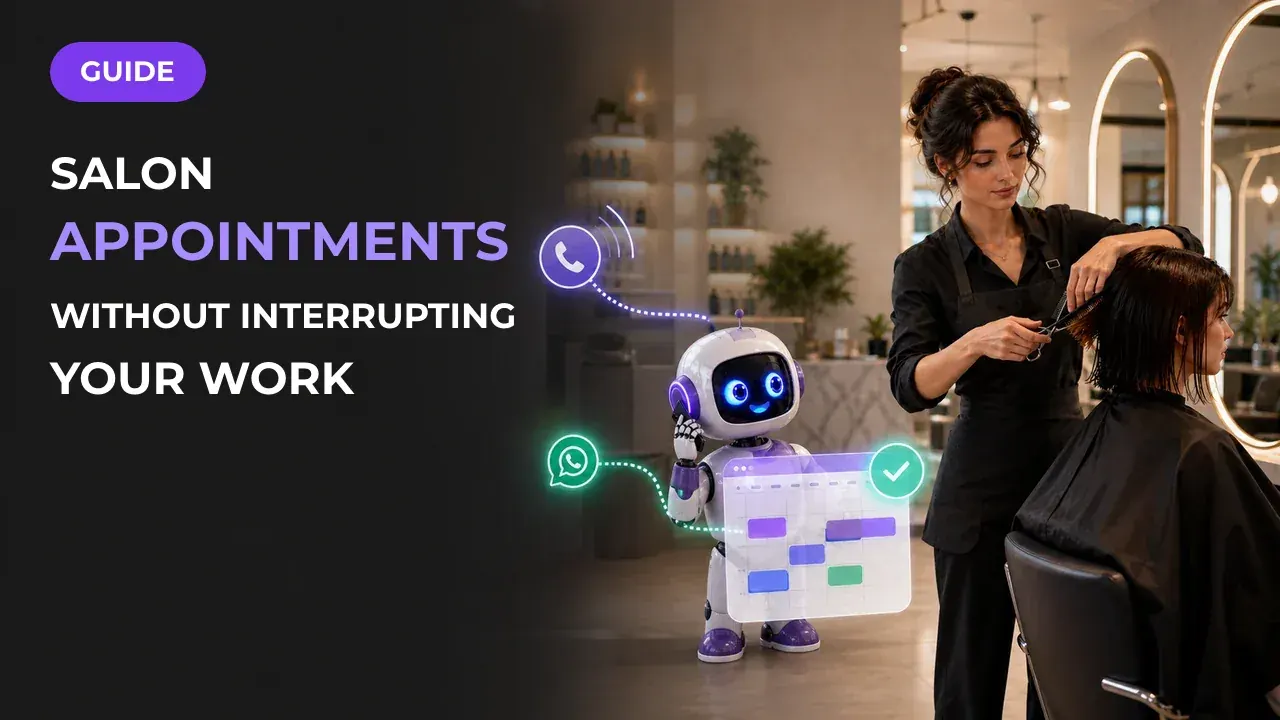
Consider a hairdresser who does not have to interrupt a service to answer the phone, an estate agent who arrives prepared for a viewing because the request has already been qualified, or a receptionist who can calmly welcome the patient standing in front of them.
In these cases, automation does not remove the relationship. It removes what prevents people from giving that relationship their full attention.
Time saved must become genuine attention
Automation alone is not enough. The advantage exists only when the recovered time improves human work: preparing for a conversation, reading the collected context, welcoming someone without rushing or handling an exception properly.
If a company automates repetitive steps but continues to ignore complex requests, the underlying problem remains. Technology creates capacity; the organisation decides how to use it.
The problem is not using AI; it is using AI badly
An artificial assistant can make an experience colder when it is designed without considering the customer.
This happens when it:
- repeats generic answers without understanding the request;
- prevents the customer from speaking with a person;
- tries to manage situations that are too sensitive;
- uses a distant or unnatural tone;
- asks too many unnecessary questions;
- fails to retain information already received;
- does not explain the next step;
- continues a conversation when it should transfer it.
Experience quality therefore depends on design.
A good AI assistant should not pretend to be a person or hold the customer at any cost. It should understand the goal of the conversation, collect only the necessary information, provide a useful response and recognise when somebody else needs to become involved.

When AI should pass a conversation to a person
Setting boundaries is essential. Every company should define which requests can be handled automatically and which need human involvement.
A handoff may be appropriate when:
- the customer expresses strong dissatisfaction;
- the request involves a sensitive health, legal or financial situation;
- a professional assessment is required;
- conditions or prices need to be negotiated;
- the customer explicitly asks for a person;
- the conversation moves outside anticipated cases;
- an urgent situation needs to be assessed;
- the decision carries significant responsibility.
The handoff should not erase work already completed. Collected information must travel with the request so the person enters with context and does not ask the customer to repeat everything.
People and AI: give each the part it handles best
The balance between automation and relationships changes by industry. There is no single boundary that works for every business.
Dental practice
AI can collect the request, distinguish a routine check-up from a possible urgent need and check availability. Diagnosis and clinical guidance remain with the professional.
Estate agency
It can ask about location, budget, property type and availability for a viewing. Advice, negotiation and market knowledge remain with the agent.
Law firm
It can collect initial details, understand the general area of the request and organise a first appointment with the right professional. Case assessment and legal advice belong to the lawyer.
Automotive
It can identify the model of interest, gather information about a possible trade-in, book a test drive or arrange a workshop appointment. Negotiation and commercial advice remain with the salesperson.
Hair salons and beauty centres
It can provide information about services, check availability and book an appointment. Treatment advice and the salon experience remain in the professional's hands.
How Agendly combines automation with human attention
Agendly handles inbound phone and WhatsApp conversations, responds to requests, collects the necessary information and organises appointments in one calendar.
This allows companies to remain available when staff are busy, outside working hours or occupied with other customers.
The value is not only faster responses. It is continuity: the customer is welcomed, the request is understood and information reaches the right person without disappearing between phone calls, notes and separate conversations.
When human involvement is needed, the professional can enter with more context and greater availability.

The most useful technology creates more space for people
Artificial intelligence does not automatically make a relationship colder, just as the presence of a person does not automatically make it more human.
What matters is attention, response quality and the ability to understand what the customer needs at that moment.
Used in the right steps, AI can remove waiting, interruptions and repetitive work. People can then dedicate more time to conversations where empathy, experience and trust are indispensable.
The question is not “do we want to replace human relationships?” It is: “which activities can we give to technology to make everything else more human?”
FAQ
Will customers accept speaking with an AI assistant?
It depends on the experience quality and type of request. For simple tasks, many customers value a clear, immediate answer. They must still be able to reach a person when the situation requires it.
Which conversations should not be automated?
Those requiring diagnosis, professional advice, significant empathy, negotiation, complex complaint handling or decisions carrying meaningful responsibility.
Should an AI assistant pretend to be human?
No. It should communicate naturally and transparently without deceiving the customer. Its purpose is to make the request easier, not imitate a person at any cost.
How do you prevent a rigid experience?
Define clear goals, essential questions, context to preserve, exceptional cases and explicit rules for transferring the conversation to a person.
Does automation replace customer service?
No. It can manage availability, data collection, recurring answers and appointments. The team retains conversations requiring judgement, expertise and relationships.
Want to understand which requests Agendly can handle for your company?
We can analyse frequent conversations, define automation boundaries and build a flow that leaves your team more time for customers without blocking access to a person when one is needed.